Discover how an AI textbook assistant can help students understand difficult concepts, practice for exams, and learn smarter with curriculum-based artificial intelligence.
Education is changing rapidly, and artificial intelligence is becoming an important part of how students study. In 2026, students need more than a traditional textbook or a general-purpose chatbot. They need an intelligent learning assistant that explains concepts clearly, answers questions accurately, and helps them prepare for exams.
An effective AI textbook assistant combines textbook-based learning, personalized explanations, interactive quizzes, and intelligent revision tools in one place.
Platforms like MyTextbookAI.com aim to make learning more accessible by bringing AI-powered assistance directly into the textbook learning experience.
In this article, we explore the essential features every effective AI textbook assistant should offer in 2026.
1. Curriculum-Based AI Chat
One of the most important features of an AI textbook assistant is the ability to answer questions based on the student's actual syllabus.
General AI chatbots may provide broad information that does not always match a student's school curriculum. A curriculum-based AI assistant focuses on relevant subjects, chapters, and topics.
Students should be able to:
- Select their class or grade.
- Choose a subject and chapter.
- Ask questions about specific topics.
- Receive explanations aligned with their syllabus.
- Explore related concepts without losing the context of the chapter.
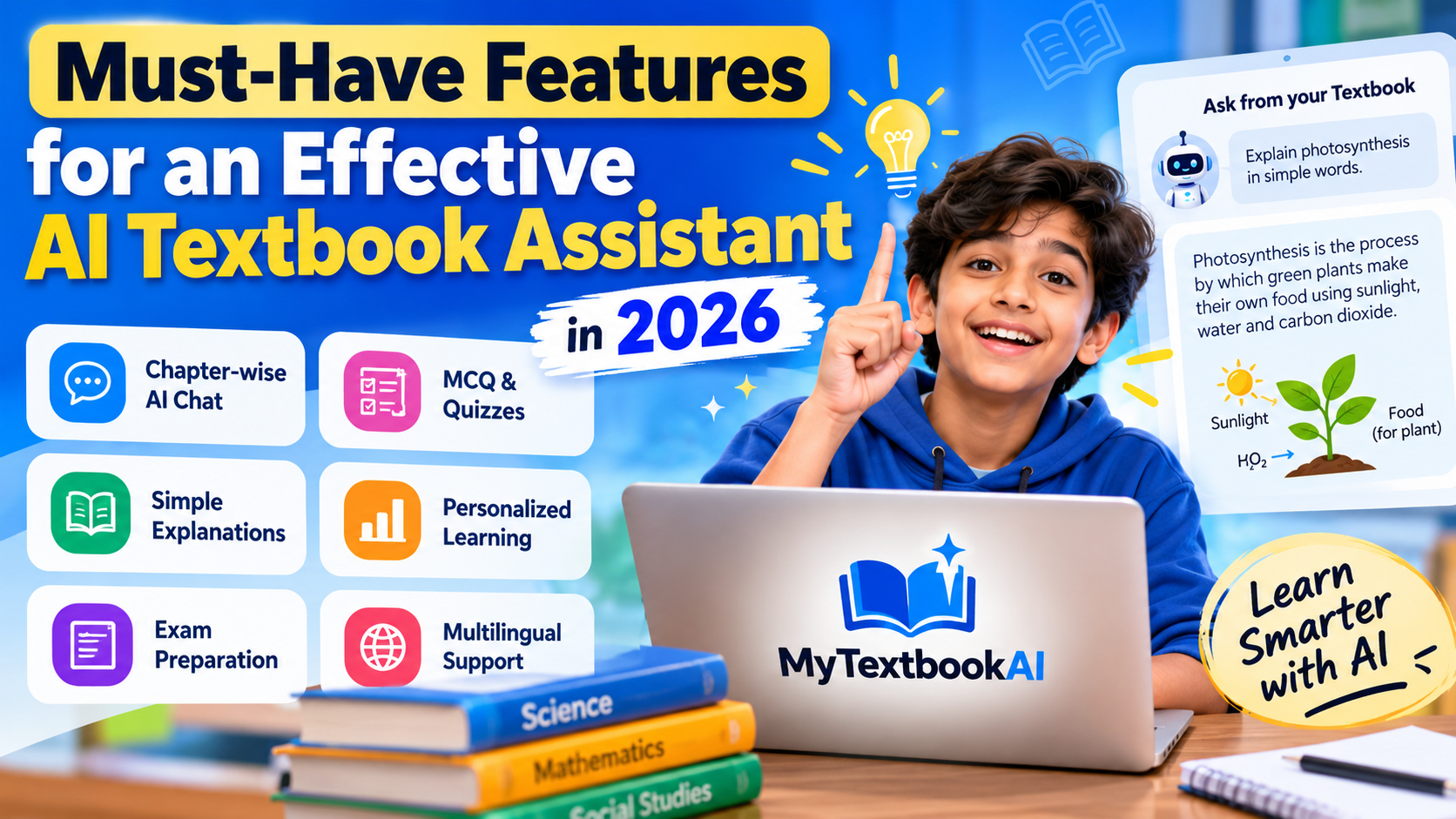
For example, a student studying photosynthesis can ask, "Explain photosynthesis in simple words," and receive an explanation suited to their grade level.
Why it matters: Students spend less time searching for relevant information and more time understanding what they need to learn.
2. Chapter-Wise AI Learning
A good AI textbook assistant should organize learning around chapters rather than treating every question as an unrelated conversation.
Chapter-wise learning helps students focus on one topic at a time, understand how concepts connect, and revise systematically before examinations.
Useful capabilities include:
- Chapter-specific AI conversations.
- Topic explanations and summaries.
- Important definitions and key concepts.
- Examples related to the lesson.
- Follow-up questions based on the same topic.
This approach makes it easier for students to move from basic understanding to more advanced concepts.
3. Simple Explanations for Difficult Topics
Every student learns differently. Some understand a concept after reading a textbook, while others need examples, analogies, or step-by-step explanations.
An effective AI study assistant should adapt its explanations to the student's needs.
For example, it could explain a scientific concept in three ways:
- Simple explanation: A beginner-friendly overview.
- Detailed explanation: A deeper look at the concept.
- Practical example: A real-world situation that demonstrates how it works.
Students should also be able to ask follow-up questions whenever something remains unclear.
The goal is not simply to provide an answer. It is to help students understand why the answer is correct.
4. AI-Powered MCQ and Quiz Generation
Practice is essential for identifying knowledge gaps and preparing for exams. An AI textbook assistant should make it easy to generate practice questions from the topics students have studied.
Important quiz features include:
- Multiple-choice questions (MCQs).
- Chapter-wise practice tests.
- Easy, medium, and difficult questions.
- Instant answer checking.
- Explanations for correct and incorrect answers.
- Score summaries and recommendations for further practice.
For example, after completing a chapter on the human digestive system, a student could generate a 20-question MCQ test to check their understanding.
A stronger system would identify the topics where the student struggles and recommend additional practice.
5. AI Exam Preparation
Exam preparation is one of the most valuable uses of an AI textbook assistant.
Instead of revising an entire textbook repeatedly, students can use AI to create a structured revision plan based on their syllabus, available time, and areas of weakness.
An effective exam preparation system should support:
- Chapter-wise revision.
- Important concepts and definitions.
- Practice question papers.
- Mock tests.
- Short-answer and long-answer practice.
- Last-minute revision notes.
- Feedback on mistakes and weak topics.
AI-generated practice papers should clearly be identified as practice material, not guaranteed predictions of actual examination questions.
The best approach combines regular revision, active recall, and practice tests rather than relying entirely on memorized answers.
6. Personalized Learning Experience
Not every student has the same level of understanding. An effective AI textbook assistant should help learners progress at a suitable pace.
Personalization can include:
- Adjusting explanations to the student's grade level.
- Recommending topics based on quiz performance.
- Revisiting concepts the student finds difficult.
- Increasing question difficulty as understanding improves.
- Suggesting what to study next.
For example, if a student repeatedly answers questions about fractions incorrectly, the assistant could provide simpler examples and additional practice before moving to more advanced mathematics.
Over time, this can make learning more focused and efficient.
7. Instant Doubt Solving
Students often encounter questions while studying independently, especially when teachers or parents are unavailable.
An AI textbook assistant can provide on-demand support, allowing students to ask questions whenever they need help.
A useful doubt-solving feature should:
- Provide clear and relevant answers.
- Break complex problems into smaller steps.
- Explain the reasoning behind solutions.
- Allow follow-up questions.
- Acknowledge uncertainty when an answer cannot be verified.
For mathematics and science, showing the steps is particularly important. Students should understand how to solve a problem, not merely copy the final answer.
8. No-Upload Learning Experience
One useful feature of a textbook-based learning platform is access to a structured syllabus without requiring students to upload their own textbook files.
When the curriculum and learning content are already available within the platform, students can simply select their class, subject, and chapter to begin learning.
This can make the experience easier for younger students and those who are unfamiliar with document uploads or other technical processes.
A well-organized syllabus can provide:
- Direct access to subjects and chapters.
- Consistent learning material.
- Faster access to relevant topics.
- A simpler experience across devices.
For students using a platform such as MyTextbookAI.com, syllabus-based navigation can make getting started with AI-assisted learning more straightforward.
9. Smart Revision Notes and Summaries
Textbooks often contain extensive information, making revision time-consuming. An AI assistant can help students create concise notes while preserving the important concepts.
Useful revision tools include:
- Chapter summaries.
- Key points and definitions.
- Formula lists.
- Important dates and events.
- Quick revision guides.
- Flashcards for memorization.
Students should be able to choose between short summaries and detailed notes depending on their learning goals.
AI-generated summaries should remain faithful to the original curriculum and be checked for accuracy, particularly when preparing for important examinations.
10. Multilingual Learning Support
Language can be a significant barrier to understanding complex subjects. In a diverse country like India, multilingual support can make AI learning tools more accessible.
A useful AI textbook assistant should support English and, where available, Indian languages such as Hindi and Gujarati.
Students could ask a question in their preferred language and receive an explanation they can understand comfortably.
For example, a Gujarati-speaking student studying science in English might ask for a difficult concept to be explained in Gujarati while keeping important scientific terms in English.
This can help students understand the meaning of a concept before learning the formal terminology used in examinations.
11. Progress Tracking and Learning Analytics
An effective AI learning assistant should help students understand how they are progressing.
Rather than focusing only on the number of questions answered, progress tracking should provide meaningful insights into understanding and revision needs.
Useful indicators include:
- Quiz scores over time.
- Chapters completed.
- Strong and weak topics.
- Accuracy by subject.
- Revision recommendations.
- Practice consistency.
These insights can help students make better decisions about what to study next.
Progress tracking should also protect student privacy and use learning data responsibly.
12. Mobile-Friendly and Accessible Design
Students may study on smartphones, tablets, laptops, or desktop computers. An AI textbook assistant should work smoothly across different screen sizes.
A student-friendly interface should offer:
- Simple navigation.
- Fast loading times.
- Readable text and clear layouts.
- Easy access to subjects and chapters.
- Comfortable chat and quiz interfaces.
- Accessibility features where possible.
Voice interaction and text-to-speech can provide additional flexibility for students who prefer listening or speaking rather than typing.
A good interface should make studying easier, not introduce unnecessary complexity.
13. Accurate Answers and Responsible AI
Accuracy is essential when AI is used for education. An incorrect explanation can confuse students and reinforce misunderstandings.
An effective AI textbook assistant should prioritize trustworthy answers through features such as:
- Curriculum-grounded responses.
- References to relevant chapters or learning materials where available.
- Clear step-by-step reasoning.
- Appropriate handling of ambiguous questions.
- Honest acknowledgment of uncertainty.
- Safeguards suitable for younger learners.
The assistant should also encourage students to think independently instead of simply completing every assignment for them.
Hints, guiding questions, and explanations can help students develop problem-solving skills and genuine understanding.
14. Affordable and Easy Access to Learning
Access to quality educational support should not depend entirely on a student's ability to pay for private tutoring.
AI textbook assistants can provide another source of learning support by helping students understand lessons, practice questions, and revise independently.
A useful platform should make its features and pricing clear, offer a straightforward onboarding experience, and work reliably for students with different devices and internet conditions.
For Indian students, affordable access and support for local curricula and languages can be particularly valuable.
How MyTextbookAI Fits into the Future of Learning
MyTextbookAI.com focuses on bringing AI assistance into the textbook learning experience.
By organizing learning around classes, subjects, and chapters, a textbook-focused AI platform can help students explore their syllabus, clarify doubts, and prepare for examinations without relying solely on general-purpose AI tools.
Core capabilities such as chapter-wise AI chat, exam generation, and MCQ practice can support students at different stages of learning.
The broader opportunity is to make textbook learning more interactive, accessible, and personalized while keeping the curriculum at the center of the experience.
Students should still use their prescribed textbooks, follow their teachers' guidance, and verify important information when necessary.
How to Choose the Right AI Textbook Assistant in 2026
Before choosing an AI study platform, students and parents should consider the following checklist:
- Does it support the student's class, subjects, and curriculum?
- Can it explain difficult concepts in simple language?
- Does it provide chapter-wise learning?
- Can students generate MCQs and practice tests?
- Does it support exam preparation and revision?
- Are answers accurate and appropriately grounded in learning materials?
- Does it help students understand mistakes?
- Is it easy to use on mobile devices?
- Are privacy protections and pricing clearly explained?
The right platform should help students become more independent learners rather than making them dependent on AI for every answer.
Conclusion
In 2026, an effective AI textbook assistant should do much more than answer questions. It should help students understand concepts, practice regularly, identify weaknesses, and prepare confidently for examinations.
The most valuable features include curriculum-based AI chat, chapter-wise learning, simple explanations, MCQ generation, exam preparation, personalized revision, and trustworthy answers.
When these features work together, AI can become a practical learning companion that supports both classroom education and independent study.
If you want to explore AI-powered textbook learning, visit MyTextbookAI.com and discover how AI can support your study routine.
Learn smarter. Understand better. Prepare with confidence.
Frequently Asked Questions (FAQs)
1. What is an AI textbook assistant?
An AI textbook assistant is an educational tool that uses artificial intelligence to help students understand textbook concepts, answer questions, practice quizzes, and prepare for examinations.
2. What are the most important features of an AI textbook assistant in 2026?
The most important features include curriculum-based AI chat, chapter-wise learning, step-by-step explanations, MCQ generation, exam preparation, personalized revision, and reliable answers.
3. Can AI help students prepare for exams?
Yes. AI can help students revise chapters, generate practice questions, identify weak topics, and create mock tests. Students should combine these tools with their prescribed syllabus and regular study.
4. Is an AI textbook assistant better than a general AI chatbot?
A textbook-focused assistant can be more useful for syllabus-based study because it organizes learning around specific subjects and chapters. Its usefulness depends on the quality and accuracy of its curriculum content and responses.
5. Can AI textbook assistants help students who struggle with difficult subjects?
Yes. They can provide simpler explanations, worked examples, hints, and additional practice. Students can revisit concepts at their own pace and ask follow-up questions when needed.
6. Where can students explore AI-powered textbook learning?
Students can visit MyTextbookAI.com to explore its AI-assisted textbook learning experience.
Suggested SEO title: Must-Have Features of an AI Textbook Assistant in 2026
Suggested meta description: Discover the must-have AI textbook assistant features in 2026, including chapter-wise AI chat, MCQ quizzes, exam preparation, personalized learning, and smart revision.
Suggested URL slug: /blog/must-have-ai-textbook-assistant-features-2026
Suggested primary keyword: AI textbook assistant
Suggested secondary keywords: AI study assistant, AI learning tools for students, AI exam preparation, AI MCQ generator, personalized learning with AI, AI textbook learning